
This country is perfect place for sandboarding on massive dunes, stargazing in the desert and watching wild animals
One of the favourite countries for a family adventure in Africa. Located along the Atlantic Ocean coast, this place offers a diverse experience for family vacation. There are plenty of things to do and places to visit in Namibia. Planning a family vacation to Namibia, means you’re in for a true adventure.
With its wide-open landscapes, friendly locals, and endless opportunities for kids to explore nature and wildlife, Namibia is a perfect destination for family travel. Namibia brings together culture, tradition, nature and adventure for all age groups. For us, Namibia is a safe place to visit in Africa with plenty of things to do with the kids.
From sandboarding on massive dunes to spotting elephants on safari, there’s something here for every member of the family — whether you’re traveling with toddlers, tweens, or teens.
With this guide, we’ve handpicked the 10 best things to do in Namibia with kids, complete with family travel tips and itinerary insights to help you plan a smooth and unforgettable trip.
1. Climb the Dunes of Sossusvlei Together
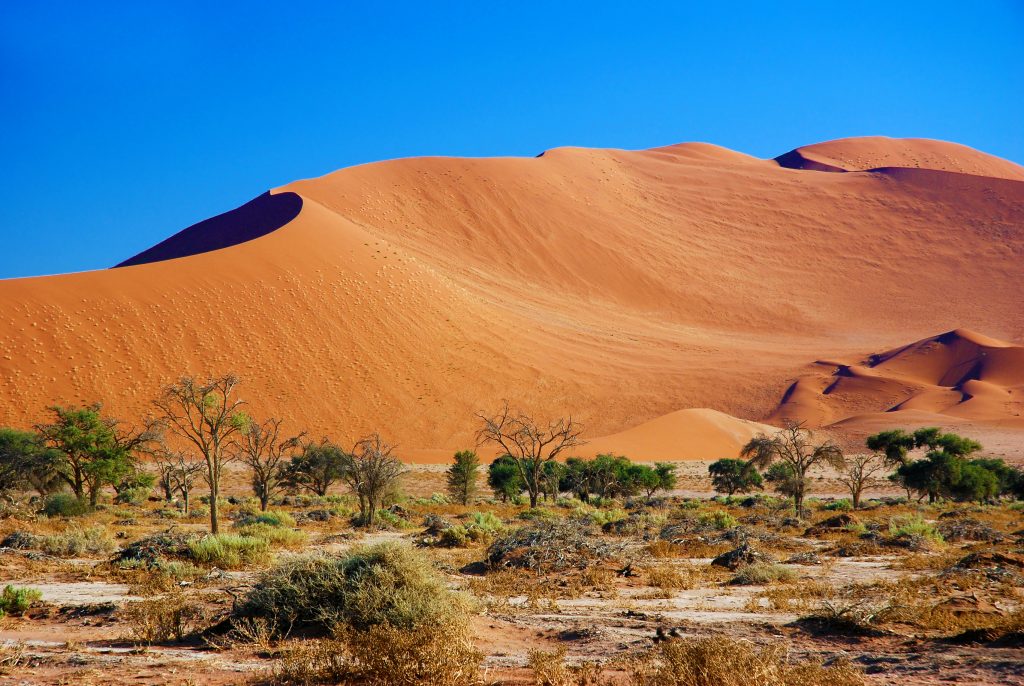
Climbing the towering red dunes of Sossusvlei in the Namib Desert was a wonderful experience, It’s like stepping into a storybook.
You can run barefoot down the soft slopes of Dune 45. This is an exhilarating way to descend this famous Namibian sand dune. We then explored the Deadvlei, where ancient, dead trees stand in a clay pan like a scene from another planet. There is something a bit eerie about how everything looks here.
Sossusvlei is all salt, clay, and sand, with amazing red dunes arching and curling seemingly forever as the eyes can see. It is located in the southern part of the Namib Desert and is part of the Namib Sand Sea UNESCO World Heritage Site. From the air, while flying was a breathtaking and beautiful experience.
Standing at the base of Dune 45, I realized how small I felt in the face of nature. The sand was golden red, and the climb looked impossible at first. But step by step, with my kids scrambling ahead and my partner pacing behind, we made it to the top.
The view was worth every drop of sweat. From the ridge, all you see are endless dunes rolling like waves into the horizon. Sunrise here is magical. The colors shift from purple to orange to fiery red. If you’re traveling as a family, climbing together turns into a shared victory.
Family Travel Tip: Bring sunscreen, hats, and plenty of water. For younger kids, sunrise and sunset are ideal when the temperatures are cooler and the lighting is magical. It gets very hot quickly in the morning through late evening. Even at night it will still feel very warm and dry.
2. Spot Elephants and Lions in Etosha National Park
This is a dream world for young children. What child doesn’t dream of seeing elephants, giraffes, and lions in the wild? In Etosha National Park, you can do exactly that — and it’s one of Africa’s most family-friendly safari destinations.
Etosha’s waterholes are prime locations to observe elephants. They are most active during the early morning or late afternoon when animals are most active. The Okaukuej camp’s waterhole is particularly famous for its wide variety of wildlife activity, especially elephants, lions, and rhinos.
Etosha’s self-drive safari system makes it easy to go at your own pace. Drive between waterholes and watch wildlife from your car or lodge.
Etosha was unlike any safari I had ever done. The salt pan stretches so wide it looks like a mirage. Our drive from waterhole to waterhole, was where the magic happened.
We saw elephants lumbering in the dust, lions resting under trees, and even a rhino crossing the road right in front of us. We couldn’t believe how close the giraffes got to our car.
The best part? You don’t have to be an expert safari-goer. Etosha is perfect for self-drives, which makes it affordable and family-friendly.
Family Travel Tip: Choose a lodge with a floodlit waterhole (like Okaukuejo) so the kids can watch wildlife safely at night.
3. Play and Explore in Swakopmund
Swakopmund is a popular stop on many Namibian road trips. It’s conveniently located between Sossusvlei and Etosha. Swakopmund is Namibia’s adventure hub — enjoy beach time, fun activities, and German pastries. Visit museums or go on dolphin and seal cruises. The wild Atlantic Ocean is on the city’s west coast and red sand dunes in the distance. Swakopmund offers families on vacation a peaceful spot to get away
Go sandboarding or quad biking in the dunes (suitable for older kids), take a dolphin and seal cruise from nearby Walvis Bay, or visit the Swakopmund Museum, which offers hands-on exhibits that kids will love.
After the heat of the desert, Swakopmund felt like a breath of fresh air. The German influence is obvious—bakeries serving apple strudel, pastel-colored houses, and a coastal vibe.
For families, this is playtime. We tried sandboarding, quad biking, and even a dolphin cruise. My kids loved running along the beach, though the Atlantic water was ice-cold.
It’s also a good place to recharge. There are plenty of cafes, restaurants, and safe spots to wander.

Family Travel Tip: Try out the Kristall Galerie where kids can see massive quartz crystals — and even dig for their own in the sand pit.
4. Stargaze in the Namib Desert
Namibia is one of the best stargazing spots in the world, thanks to its dry climate and low light pollution. It’s the kind of experience you don’t plan—you just have to be there.
If your kids have never seen the Milky Way, Namibia’s NamibRand Nature Reserve will absolutely blow their minds. With almost zero light pollution, it’s one of the darkest skies in the world — perfect for stargazing. Known for its crystal clear night sky, we find the best time for stargazing is during the dry season (May to October) offering particularly crisp, clear views of the cosmos. The desert is at its driest so there is less dust and dirt in the air.
We think the Namib Desert has to be rated one of the most beautiful deserts in the world. It stretches along the Atlantic coast of Namibia. The deep orange sand dunes create a unique beauty that must be seen. The sand dunes are constantly shifting and changing with the wind, providing a stunning landscape. Its vastness is perfect for star gazing.
Many lodges offer telescopes and stargazing sessions, and some even have open-air beds where you can sleep under the stars as a family.
The Namib Desert is known for its crystal clear night sky, but the best time to go star gazing is between May and August when the sky is at its clearest. This is because the desert is at its driest during this time, meaning there is less dust and dirt in the air. During this time, you can expect to see thousands of stars in the night sky, so be sure to bring a telescope to get the best view.
Family Travel Tip: Bring a stargazing app or constellation guide and let your kids lead the way.
5. Discover the Quirky Wildlife of the Skeleton Coast
Explore the seal colony at Cape Cross and the shipwreck-dotted coastline. While the name might sound spooky, the Skeleton Coast is anything but. Shipwrecks dot the coastline, fog drifts inland, and seals bark loudly at Cape Cross.
This rugged stretch of foggy coastline is home to huge seal colonies, scattered shipwrecks, and dramatic desert scenery. Driving along the Skeleton Coast felt like stepping onto another planet.
A guided drive through the Skeleton Coast Park is a fun adventure for older kids, while the seal colony at Cape Cross (home to over 100,000 Cape fur seals!) is sure to amaze younger children.
The seal colony here is massive—thousands of them lounging, barking, and fighting. It’s loud, smelly, and unforgettable.
The Skeleton Coast reminds you how raw and powerful nature is. It’s not about beauty in the traditional sense—it’s about drama.
Family Travel Tip: It’s windy and can be chilly here, so bring jackets and be prepared for strong ocean smells at the seal colonies!
6. Learn from the Himba People in the North
Visit a Himba community to understand their nomadic culture, traditions, and lifestyle. Introduce your children to different cultures with a visit to a Himba community in northern Namibia. The Himba are known for their red ochre body paint, traditional hairstyles, and nomadic lifestyle.
Some community-based tours offer hands-on activities like trying traditional food, understanding how homes are built, or learning Himba dances.
Visiting a Himba community was one of the most meaningful parts of our trip. The Himba are semi-nomadic and famous for their red ochre-covered skin and braided hairstyles.
We were welcomed warmly, and I was humbled by how much they shared about their traditions, family life, and connection to the land. My children asked questions, and the Himba kids giggled and played with them.
It wasn’t about taking photos—it was about listening, learning, and appreciating a culture different from our own.
Family Travel Tip: Go with a respectful local guide who can translate and explain traditions. Always book through a responsible, ethical tour operator that supports the local community.
7. Visit the Quiver Tree Forest
South of Windhoek lies a place that feels almost magical: the Quiver Tree Forest. The trees, with their strange shapes and smooth bark, look like something out of a fantasy book.
Located near Keetmanshoop in southern Namibia, the Quiver Tree Forest is home to some of the most unusual trees your kids will ever see. These spiky, towering aloes look like they belong in a fantasy movie.
We arrived at sunset, and the golden light made the trees glow. Walking among them, we took family photos that became some of my favorites from the whole trip.
The area is peaceful, and you’ll likely have it almost to yourself.
.Nearby is the Giant’s Playground, a surreal field of boulders stacked like blocks. It’s a great place for climbing and imaginative play.

Family Travel Tip: Go at sunrise or sunset for beautiful family photos and cooler temperatures.
8. Take a Scenic Flight Over the Namib Desert
If you want to feel the scale of Namibia, take a scenic flight. I saved up for this, and it was worth every cent. From above, the dunes stretch endlessly, rivers cut through the sand, and you can even see the coast meeting the desert.
It’s surreal. We pressed our noses against the glass the entire flight. It was like seeing another planet.
You can see and marvel dunes, shipwrecks, and desert-adapted wildlife from the air.
A scenic flight over the dunes and coastline offers a whole new perspective — and is an unforgettable family experience.
Kids can marvel at:
- Shipwrecks scattered along the Skeleton Coast
- The waves of red sand in Sossusvlei
- Desert-adapted wildlife from above
Family Travel Tip: Flights depart from Swakopmund or Sesriem. Morning flights often have calmer air.
9. Hike (a Little) in Fish River Canyon
Visit Africa’s Grand Canyon with safe viewpoints and short walks near Hobas. Nestled within the desolate beauty of southern Namibia, Fish River Canyon is a natural wonder.
Fish River Canyon — Africa’s Grand Canyon — is a dramatic natural wonder that’s worth a family stop, even if you don’t do the full 5-day hike.
There are safe viewing platforms where you can peer into the canyon’s depths, take in the views, and enjoy a family picnic.
To visit Fish River Canyon, from the Hobas entrance in southern Namibia, you head to the Main Viewpoint and other accessible points like Senderista Viewpoint and Sulphur Spring Viewpoint. Short, safe walks are possible at these viewpoints, offering spectacular panoramas of the canyon’s vastness, with the main park entrance located at Hobas camp.
Family Travel Tip: Pack snacks and enjoy a picnic while taking in the view.
10. Go on a Self-Drive Road Trip Adventure
Driving in Namibia is an adventure all on its own. Wide-open roads, minimal traffic, and landscapes that change every hour—it’s freedom.
We rented a 4×4 and set off with camping gear. The kids loved the sense of exploration. Each day brought something new: desert, coast, wildlife, or quirky small towns.
A self-drive road trip is perfect for families. You set your own pace, stop when you want, and enjoy the journey as much as the destination.
Namibia is one of the safest, easiest countries in Africa for self-driving — making it perfect for families who love road trips.
You’ll find:
- Well-maintained gravel roads
- Family-friendly lodges and guest farms
- Epic scenery to keep everyone entertained
Driving from Windhoek to Sossusvlei, then to Swakopmund, Damaraland, and Etosha makes for a classic route with variety and balance.
Family Travel Tip: Stock up on snacks, games, and playlists. Many lodges have pools and kid-friendly meals.
Final Thoughts: Why Namibia Is a Family-Friendly Dream Destination
Our two week stay in Namibia was exhilarating. Namibia offers the best of both worlds — wild nature and real comfort. It’s a place where your kids can run through dunes, learn about ancient cultures, see wild animals, and sleep under the stars — all while being safe, well-fed, and amazed every day.
Whether you’re on a two-week self-drive or a guided family safari, Namibia is an adventure you and your children will never forget.
Namibia isn’t just a destination. It’s a journey into vastness, wonder, and connection. From climbing dunes to meeting the Himba people, every moment felt alive and shared.
If you’re planning a trip with family, friends, or even solo, Namibia gives you space to explore and experiences you’ll remember for a lifetime. It’s not always easy travel—roads are long, the sun is hot—but it’s a rewarding trip. We think it’s worth trading theme parks for the wild year in Namibia.
Want help planning your family trip to Namibia? Drop a comment, reach out for personalized recommendations, or explore our sample Namibia itineraries for families!