Etosha National Park Review: Is It Worth It?
The first time Etosha clicks, it is usually at a waterhole. You wait through heat, glare, and a stretch of apparent nothing, and then the scene changes fast – zebra pressing in from one side, springbok holding back, elephants arriving with complete authority. That is the heart of this Etosha National Park review: Etosha is not a park that performs on command, but when it delivers, it feels raw, spacious, and distinctly Namibian.
For travelers planning a safari in southern Africa, Etosha often comes up beside better-known names in Botswana, South Africa, and Kenya. It deserves that company, but it offers a different rhythm. This is a self-drive-friendly park built around open plains, salt pan landscapes, and strategic waterholes rather than dense big-cat drama every hour. If your idea of a great safari includes independence, wide horizons, and excellent wildlife viewing without constant convoy traffic, Etosha can be a very smart choice.
Etosha National Park review: what stands out most
Etosha’s strongest feature is how accessible it feels without losing its wild edge. Roads between major areas are manageable for regular visitors, the camp network is practical, and the wildlife viewing can be outstanding, especially in the dry season. You do not need a luxury lodge budget to have a rewarding experience here.
The landscape also gives Etosha a character many parks do not have. The enormous salt pan, pale soils, thorn scrub, and shimmering heat create a stark beauty that photographs well and feels unlike classic riverfront safari country. This is not lush, cinematic Africa in the usual sense. It is harder, drier, and more atmospheric.
That said, Etosha is not perfect for every traveler. If your main goal is seeing large numbers of predators in close action every single day, there are parks that are more reliable for that. If you want deeply off-grid exclusivity, Etosha’s popular camps and public roads can feel a little structured. The right review of Etosha has to hold both truths at once.
Wildlife in Etosha: excellent, but shaped by the terrain
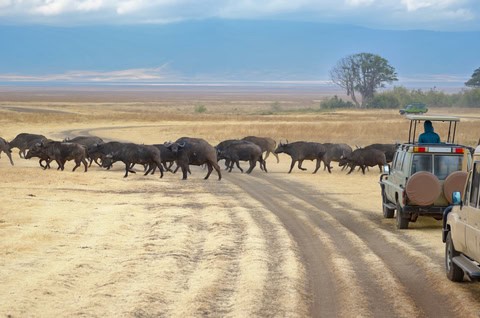
Etosha is particularly rewarding for herbivore sightings and for the drama that gathers around water. Expect strong chances of seeing elephant, giraffe, zebra, blue wildebeest, springbok, gemsbok, kudu, and often black-faced impala in some areas. Etosha is also one of the best places in Africa to see black rhino, which alone makes the park stand out.
Predators are present, and they matter here, but they are not always as immediately visible as prey species. Lions are the most likely big predator sighting for many visitors, while leopards are more elusive and cheetahs tend to reward patience and luck. Hyenas and jackals also add to the park’s predator story, especially around camps and waterholes.
Birding can be surprisingly strong depending on season and rainfall. Even travelers who do not consider themselves birders often end up paying attention here because the landscape makes each sighting feel more dramatic.
One of the best parts of Etosha wildlife viewing is behavioral observation. Because animals come to fixed water sources, you often get time to watch interactions unfold rather than racing after sightings. That slower pace suits travelers who enjoy reading the landscape, not just ticking species off a list.
Is Etosha good for a self-drive safari?
Yes – and this is one of the biggest reasons many travelers love it.
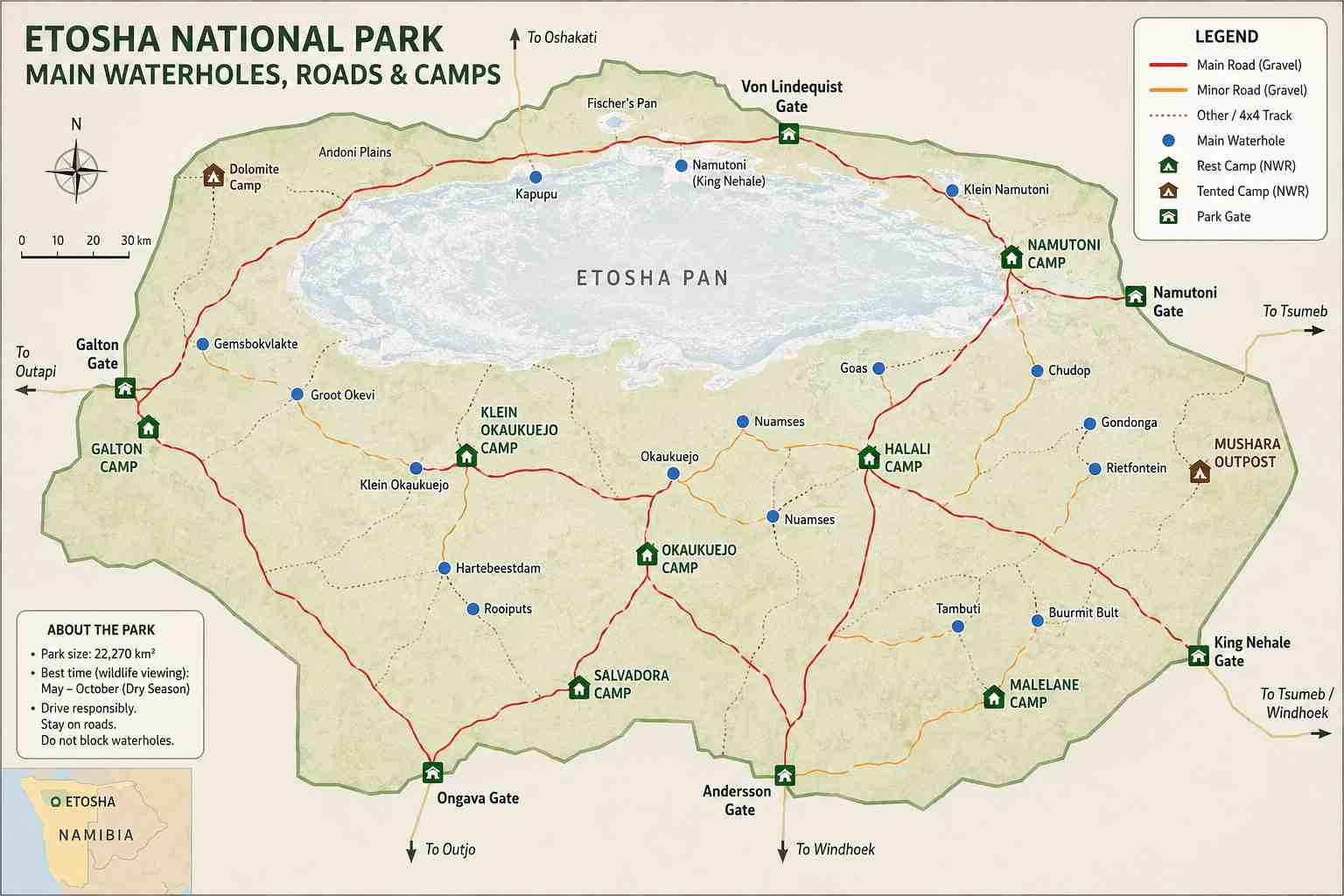
Etosha is among the most approachable major safari parks in Africa for independent travelers. The road system is straightforward enough for careful self-drivers, signage is generally clear, and the circuit between gates and camps is easier to understand than in more remote wilderness areas. For many US travelers who want the freedom of planning their own days, Etosha offers that rare balance between adventure and practicality.
Still, self-drive in Etosha works best if your expectations are realistic. You are not off-roading, and you should not expect every road to feel smooth. Distances can also be longer than they look on a map. The park rewards early starts, patient scanning, and enough time to sit at waterholes rather than constantly pushing on to the next stop.
If you prefer having every sighting interpreted for you, guided drives may feel more satisfying. But for travelers who enjoy spotting for themselves, Etosha is deeply rewarding. It gives you space to participate in the safari rather than just consume it.
Camps, comfort, and the overall visitor experience
Etosha’s main camps are functional, well-positioned, and important to the experience because several have floodlit waterholes. Watching animals come and go after dark can become a trip highlight, especially if daytime game drives have been quiet.
The trade-off is that camp experiences vary. Some travelers find them convenient and atmospheric, while others find them busy, a bit impersonal, or less polished than private lodge stays elsewhere in southern Africa. That does not mean they are poor choices. It means you should choose based on travel style.
If you are budget-conscious or building a broader Namibia road trip, the public camp system makes Etosha far more accessible than many safari destinations. If you want a more refined experience, private lodges around the park’s edges can offer extra comfort, stronger service, and guided activities, though you may lose some of the direct in-park feeling.
This is where Etosha really depends on the traveler. For some, the simplicity is part of the appeal. For others, especially on a honeymoon or milestone trip, adding a more comfortable lodge before or after the park can create a better balance.
Best time to visit and how season changes the review
Any honest Etosha National Park review has to mention season because it changes the experience dramatically.
The dry season is usually the best time for classic wildlife viewing. As water becomes scarce, animals concentrate around waterholes, and sightings become more predictable. Visibility is better, roads are generally easier, and the whole safari experience feels more focused. If wildlife is your main priority, this is the strongest time to go.
The greener months can be beautiful, with softer scenery, migratory birds, and newborn animals, but sightings may feel more scattered. Some travelers actually prefer this because the park feels less harsh and sometimes less crowded, though it requires more patience.
If this is your first safari in Namibia and you want the highest chance of productive game viewing, dry season is the easier recommendation. If you are a repeat safari traveler or a photographer interested in moodier landscapes and birdlife, the green season can be a smart alternative.
What Etosha does better than many other safari parks
Etosha does scale very well. You feel the openness of Namibia in a way that few parks deliver. The setting is not just a backdrop. It shapes the wildlife experience and gives the park a strong sense of place.
It also performs well on value. Compared with some premium safari destinations in Africa, Etosha can offer very good returns for travelers who want meaningful wildlife encounters without spending at the highest end of the market. That matters for couples and families trying to balance safari dreams with real budgets.
Another strength is how well Etosha fits into a larger Namibia itinerary. It does not need to be your only destination. It combines naturally with Windhoek, Damaraland, Swakopmund, Sossusvlei, and the Skeleton Coast region, which makes it ideal for travelers who want one trip to include wildlife, landscapes, and culture.
Where Etosha can disappoint
Etosha is not a nonstop action safari. You may have stretches that feel quiet, hot, and repetitive if you are not tuned into the slower rhythm of the park. Travelers expecting dramatic predator scenes every morning can come away underrating it.
The park can also feel busy in peak periods, especially around famous waterholes and camp areas. That does not erase the experience, but it can reduce the feeling of isolation some people want from safari.
Then there is the scenery question. Some visitors fall in love with Etosha’s starkness immediately. Others find it less visually rich than greener parks. Neither reaction is wrong. This is a destination where appreciation often grows the more time you spend understanding the landscape.
So, is Etosha National Park worth visiting?
Yes – especially if you value independent travel, strong dry-season wildlife viewing, and a safari that feels tied to Namibia’s identity rather than copied from somewhere else.
Etosha may not be the best fit for travelers who want ultra-luxury throughout or who are chasing only the most dramatic predator-focused itinerary. But for many people, that is exactly why it works. It feels grounded. It asks for patience. It rewards observation. And when the light drops over a waterhole and the animals keep arriving, it can feel every bit as memorable as Africa’s more expensive safari names.
At Damtos Adventure, we see Etosha as one of those parks that often exceeds expectations when travelers understand what kind of experience it offers. Come for the wildlife, yes, but also for the space, the stillness, and the way the land itself becomes part of the story.
If you are choosing a safari that balances access, authenticity, and the thrill of genuine wildlife encounters, Etosha is an easy park to respect and a very easy one to remember.